
You've worn the brace to bed. You've raised your monitor, switched to an ergonomic mouse, maybe even had the cortisone shot. Some of it helped for a while. Then the tingling came back, or it never fully left in the first place, and now you're shaking out a numb hand at 3 a.m. wondering if surgery is really the next step, or if this is just who you are now.
Here's something most people never hear at that point: the nerve behind carpal tunnel symptoms doesn't start at your wrist. It starts in your neck. The median nerve travels from your lower cervical spine, through your shoulder, down your arm, past your elbow, and only then into the tunnel of bone and ligament where the pain gets its name. Compression can happen at any point along that path, and when it's happening at more than one point at once, treating just the wrist often isn't enough to make the symptoms stay gone.
At Van Every Family Chiropractic Center in Royal Oak, we see this pattern often enough that we evaluate the whole nerve pathway before we ever talk about the wrist alone. If you've already had wrist surgery and the numbness is still there, this may be exactly what got missed.
How Carpal Tunnel Actually Shows Up
Most people notice it first as numbness or a pins-and-needles feeling in the thumb, index, and middle fingers, often bad enough to wake them at night. As it goes on, grip strength starts to slip, a jar lid or a coffee mug that suddenly feels harder to hold, small objects that drop without you meaning to let go. Aching or sharp pain in the wrist can radiate up into the forearm, and for a lot of people the whole hand feels worse after a day of typing, gripping a wheel, or scrolling a phone. Some people also notice symptoms creeping into the shoulder or upper arm, which is often a sign the neck is part of what's going on.
The Nerve Pathway and Double Crush Syndrome
Picture the median nerve as a highway running from your neck to your fingertips. A traffic jam at the wrist slows things down. But if there's also a bottleneck further up the road, at the neck or the shoulder or the elbow, clearing the wrist alone won't restore the flow. Researchers call this double crush syndrome: when a nerve is compressed at one point, the transport system inside it gets disrupted at that first site. The rest of the nerve becomes more vulnerable to compression everywhere downstream, not just at the original spot. That's why a wrist brace can quiet the symptom for a while but the numbness so often comes right back once you take it off. It was never addressing the part of the pathway doing the real damage.
Why Wrist Surgery Sometimes Doesn't Hold
We regularly see patients who had carpal tunnel release surgery, felt better for a stretch, and then watched the numbness creep back. Studies report that somewhere between 10 and 25 percent of patients experience persistent or returning symptoms after that procedure. That's not usually a sign the surgery was done wrong. It's often a sign the cervical component was never evaluated in the first place. The surgery addressed the output, the compression at the wrist. It didn't address the signal further up the line. The same logic applies to splints, injections, and ergonomic changes. Each of those can genuinely help for a while, but if the upstream compression is still limiting nerve flow, the symptoms stay vulnerable to coming back.
Our Approach to the Whole Pathway
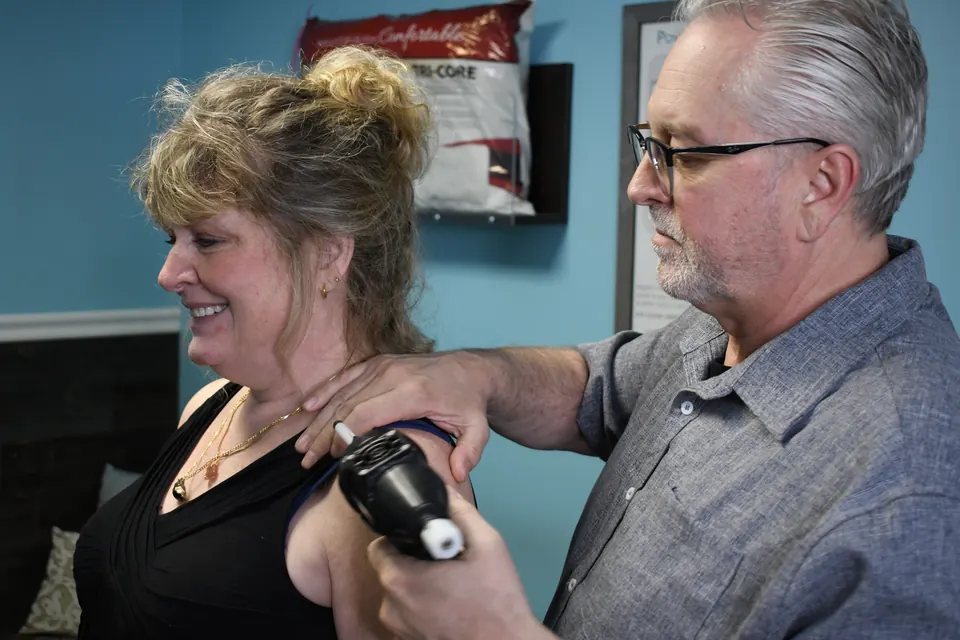
Care usually starts with an INSiGHT scan, thermal, heart rate variability, and muscle readings, that shows us where your nervous system is under stress along the arm and neck, followed by a report of findings we walk through with you in plain language. From there our doctors use Koren Specific Technique (KST) and Talsky Tonal Chiropractic (TTC), gentle, nervous system-focused contact with no cracking or twisting, to work the neck, shoulder, and wrist together rather than the wrist in isolation. If the carpal tunnel itself is actively involved, we'll also send you home with a brace to stabilize the wrist while things settle.
What Patients Often Notice
Patients often tell us the numbness and tingling ease first, sometimes without anyone touching the wrist at all, followed by steadier grip strength and fewer nights woken by a hand that's gone to sleep. Many people avoid surgery altogether once the real source of the compression is addressed, and quite a few are relieved to learn a stubborn wrist problem was never just about the wrist. As the neck tension releases, some patients also notice improvements in sleep quality and general stress tolerance they weren't expecting, since the hands were often the loudest symptom, not the only one. Progress tends to build gradually rather than all at once, and we track it with follow-up scans so it's not just a feeling, it's something we can measure and compare visit to visit.
Ergonomics and Habits That Actually Matter
A meaningful part of lasting relief happens outside the visit, in the habits that either protect the nerve pathway or keep re-straining it:
- Check your sleep position and pillow. A bent wrist or a tucked shoulder held all night can undo a week of progress
- Set up your workstation so your keyboard and mouse sit at elbow height, with wrists in a neutral, unbent position
- Take short breaks from repetitive gripping or typing every 30 to 45 minutes rather than pushing through
- Add simple stretching or strengthening for the wrist and forearm to support what care is doing between visits
- Notice whether symptoms shift with posture, if hunching at a screen makes your hand worse, that's a clue the neck is involved
Taking the Next Step
If numbness or tingling in your hand hasn't let up, or surgery gave you partial relief that didn't last, it's worth finding out where the compression actually starts. Learn more on our carpal tunnel page, download our free guide on the full nerve pathway and double crush syndrome, or book online with our doctors in Royal Oak. We also see patients on Saturdays, and you're welcome to call us at (248) 616-0900 with any questions first.
